
Executive Summary
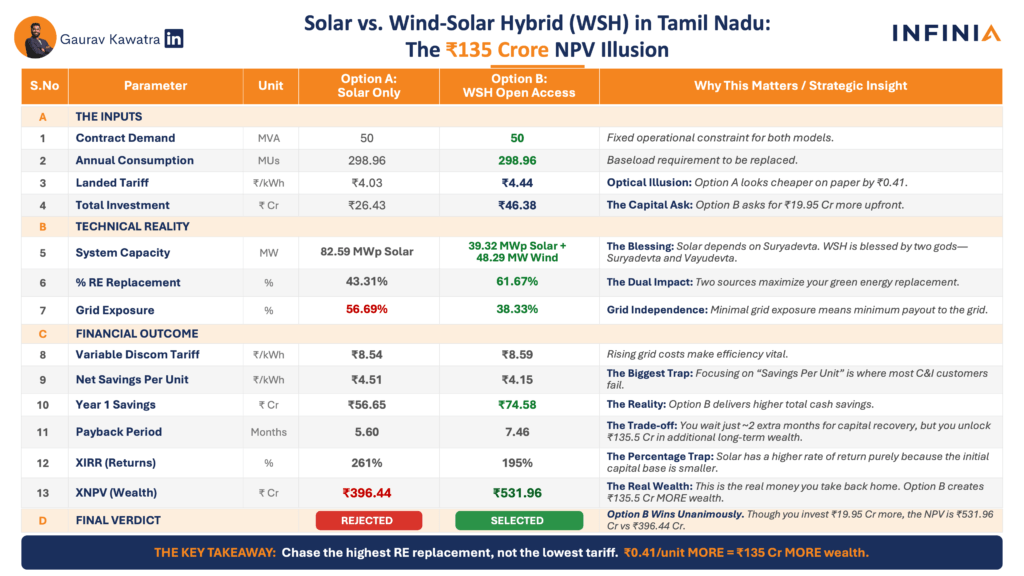
A major Steel Company in Tamil Nadu was under immense pressure. With 50 MVA Contract Demand and a ₹256.8 Crore annual electricity bill, they needed to switch to Renewable Energy. Investors and European export markets were demanding an end to “Black Power.” The CFO had two finalists: a Solar-only PPA at ₹4.03 and a Wind-Solar Hybrid at ₹4.44. While the Solar-only bid offered a higher XIRR, I forced the CFO to sign the more expensive Hybrid PPA. This post breaks down how the new Tamil Nadu Green Energy Open Access (GOA) rules rendered “cheap” solar obsolete for heavy industrial loads and how we secured unanimous Board approval by shifting the focus from tariff to Net Present Value (NPV).
The Setup: The L1 Illusion
The CFO was ready to sign with the Solar developer. On paper, it was the “no-brainer” choice:
Solar (Developer 1):
- ₹4.03/unit
- 261% XIRR
- ₹26.43 Crore Equity Investment
Hybrid (Developer 2):
- ₹4.44/unit
- 195% XIRR
- ₹46.38 Crore Equity Investment
The attractive savings per unit and the higher XIRR made Developer 1 look like the winner for the Board. But before committing, the CFO reached out to us to stress-test the math.
The Constraint: Night-Time Banking is Dead
We analyzed the proposal under the new Tamil Nadu GOA regulations.
The rule is absolute: You cannot settle day power into night power. This is where the “cheaper” deal collapsed:
- The Solar Trap: Solar generation is limited to daytime. The Steel plant’s massive night-shift manufacturing loads were left exposed to expensive grid rates. Replacement was capped at just 43.31%.
- The Hybrid Solution: Wind generation perfectly covers the night shifts, bypassing the daytime settlement restriction entirely. Replacement jumped to 61.67%.
The Verdict: More Replacement = More NPV
We moved the conversation away from the tariff and onto the Balance Sheet. By paying ₹0.41 more for the Hybrid solution and investing an additional ₹19.95 Crore upfront, the client achieved a vastly superior outcome:
- Solar-only NPV: ₹396.4 Crore
- Hybrid NPV: ₹531.9 Crore
By choosing the “expensive” developer, we created ₹135.5 Crore in additional absolute wealth. The CFO walked into the Boardroom with these numbers, and the approval was unanimous.
The Lesson for every CXO: Landed Cost Over Sticker Price
A tariff of ₹4.03 is useless if your load profile leaves your night-shift operations exposed to the grid.
Do not get trapped by a plain vanilla comparison. If you are currently evaluating an Open Access project, you must stress-test your developer’s generation profile against state-specific banking regulations.
In this session, my team and I will run a detailed audit of your project’s financial model, stress-test your infrastructure constraints, and deliver a Board-ready framework to ensure your energy strategy is mathematically unassailable.
About Infinia Solar
Infinia Solar is India’s leading renewable energy consultant.
We help Commercial and Industrial consumers procure the right renewable energy solutions, from the right developers, and on the right PPA terms.
We’ve served 60+ customers across 18 states, enabling 1.4 GW of open access and rooftop solar capacity, and have facilitated 150+ PPAs so far.
This has helped our customers reduce up to 50% of their electricity costs and replace up to 100% of their power with renewable energy.
We have also collaborated with 50+ developers, and our customers fondly refer to us as the ‘Amazon of the renewable energy industry.‘