
Executive Summary
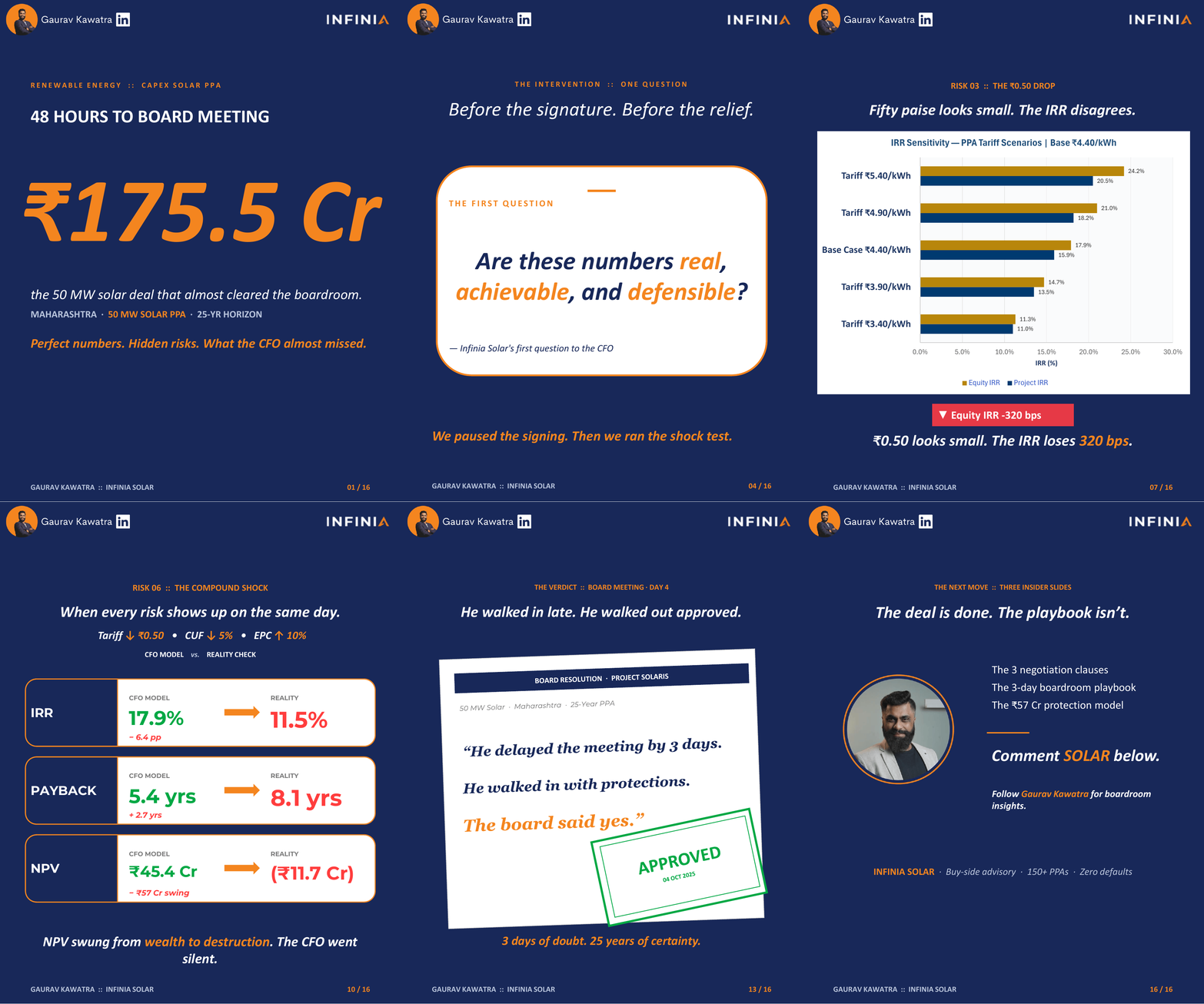
In corporate energy procurement, an attractive spreadsheet is often the fastest route to stranded capital. Recently, a CFO of a steel-manufacturing company in Maharashtra was days away from signing a ₹175.5 Crore investment for a 50 MW Solar Project. On paper, the developer’s term sheet was flawless: a 17.9% Equity IRR and a ₹45.4 Crore NPV. However, before taking this to the Board, we ran a rigorous Techno-Commercial shock test. We proved that if three standard execution risks materialized simultaneously, the project would trigger a brutal ₹57 Crore swing into wealth destruction. Here is the exact Sensitivity Analysis we used to delay the Board meeting, negotiate critical EPC protections, and secure a mathematically unassailable 25-year energy strategy.
The Setup: A Flawless Spreadsheet and a Ticking Clock
The CFO was operating under immense pressure. The Board had issued a clear ESG mandate: transition to an 80% Renewable Energy mix while maintaining strict profitability.
After six months of due diligence evaluating five different EPC players, the CFO had a finalized term sheet for a 50 MW CAPEX Solar PPA in Maharashtra. The financial model was boardroom-ready:
- Renewable Mix: 80% Target Achieved
- Equity IRR: 17.9% (Comfortably above the 15% hurdle rate)
- NPV: ₹45.4 Crores
- Payback Period: 5.4 Years
With the Board meeting just three days away, the CFO was convinced this deal would clear the room immediately. It looked like a financial no-brainer. But before pitching for the final signature, he reached out to us with one question:
“Are these numbers real, achievable, and defensible?”
The Intervention: The 5-Chart Sensitivity Test
We paused the signing. A model built purely on base-case assumptions is an incomplete frame. To survive 25 years of operational reality, a project must be stress-tested against the inevitable.
We ran the CFO’s model through our Sensitivity Analysis, isolating three specific risks that developers rarely highlight:
- The Tariff Drop: What if the open access PPA tariff drops by just ₹0.50 per unit over the horizon?
- The Generation Mirage: What if the actual Capacity Utilization Factor (CUF) degrades by 5% from the spec sheet?
- The Overrun Trap: What if the EPC costs overrun by 10% during execution?
Individually, these risks erode margins. But the real boardroom blind spot is what happens when they compound.
The Compound Shock: A ₹57 Crore Swing
We modeled the absolute worst-case scenario: what if all three of these standard execution risks happen at once? The answer literally silenced the room.
The “perfect” spreadsheet collapsed under the weight of reality:
- Equity IRR dropped from 17.9% down to 11.5%.
- Payback Period stretched from 5.4 years to 8.1 years.
- NPV crashed from +₹45.4 Crores all the way down to -₹11.7 Crores.
This wasn’t just a slight deviation in profitability. It was a brutal ₹57 Crore swing straight into wealth destruction. If the CFO had walked into the Boardroom with the original model and these risks had materialized in year two, it would have been a career-ending blind spot.
The Verdict: Managing Risk, Not Just Returns
Faced with this data, the CFO made the only mathematically sound decision available: he delayed the Board meeting by 3 days.
He went directly back to the EPC player and refused to sign the standard term sheet. Instead, armed with our analysis, he logically negotiated three critical safety nets:
- Tariff Floor: A guaranteed price mechanism to protect against the ₹0.50 drop.
- CUF Damages: Hard Liquidated Damages locked in if generation falls below the baseline.
- Fixed EPC Costs: A strict lump-sum cap with zero pass-through for overruns.
He walked into the delayed Board meeting not with an overly optimistic return model, but with named risks and signed protections. The Board approved the 50 MW deal immediately. The 3 days of doubt secured 25 years of certainty, delivering a 2,100X return on the audit.
Next Steps for the C-Suite
The deal doesn’t get approved because the returns are attractive. It gets approved because the risks are named and defended.
If your company is evaluating an Open Access Term Sheet or a massive CAPEX Solar investment, you cannot rely solely on the developer’s pitch deck.
If you want us to run a Techno-Commercial Wealth Audit to stress-test your exact PPA tariff, generation assumptions, and EPC terms before you commit your capital:
In this session, we will subject your financial model to our exact 5-Chart Sensitivity Analysis so you can walk into your next Board meeting with a mathematically unassailable energy strategy.
About Infinia Solar
Infinia Solar is India’s leading renewable energy consultant.
We help Commercial and Industrial consumers procure the right renewable energy solutions, from the right developers, and on the right PPA terms.
We’ve served 60+ customers across 18 states, enabling 1.4 GW of open access and rooftop solar capacity, and have facilitated 150+ PPAs so far.
This has helped our customers reduce up to 50% of their electricity costs and replace up to 100% of their power with renewable energy.
We have also collaborated with 50+ developers, and our customers fondly refer to us as the ‘Amazon of the renewable energy industry.‘