
Executive Summary
In boardroom energy procurement, assuming a high IRR on an Excel sheet means a Wind-Solar Hybrid PPA is a risk-free asset is a career-ending mistake.
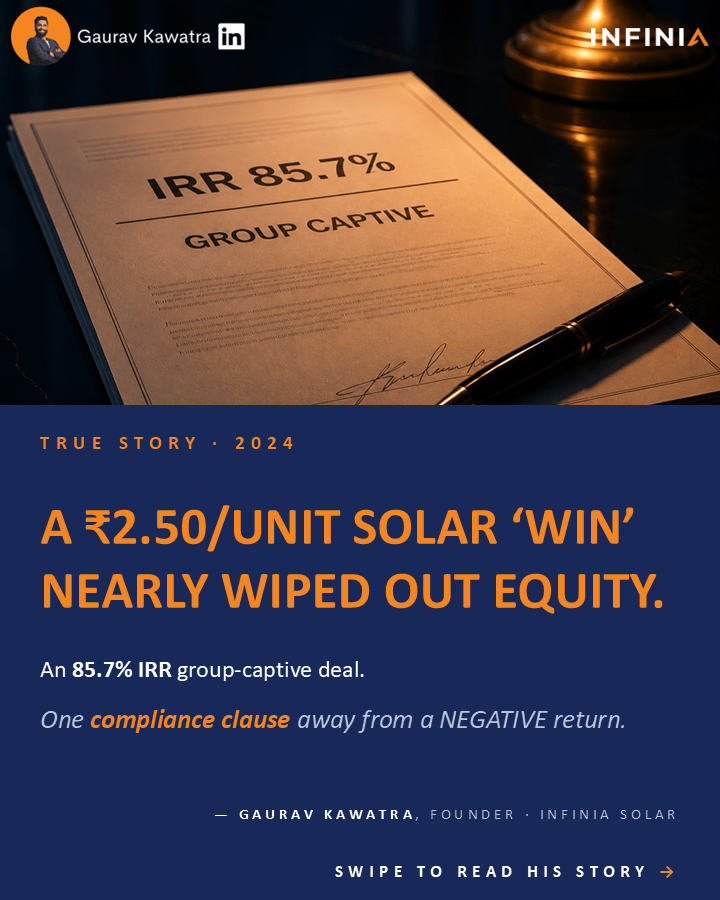
When the CFO of a Gujarat Cement company signed a 10 MW Open Access term sheet to secure ₹2.50/unit savings, his objective was simple: hit ESG goals and deliver massive returns. But he evaluated the savings and ignored the Share Subscription & Shareholders’ Agreement (SSSHA). A single boardroom confrontation revealed his “win” was just unprotected equity, flipping an 85.7% IRR into a potential negative reality.
Here is the exact framework and 7 unfiltered truths required to navigate Group Captive equity risks and secure your renewable energy strategy.
The Dilemma: The Excel Model Blind Spot
A CFO of a Gujarat Cement company was exploring a 10 MW Open Access Wind-Solar Hybrid solution.
The mandate from his Board was clear:
→ ₹2.50/unit cost saving against the DISCOM tariff.
→ ESG goals for the listed entity.
→ A clean replacement pathway to RE100 using Solar and Wind energy.
He signed the Term Sheet with the Open Access developer and took it to the Board before executing the final SSSHA. He made a short presentation, staking his credibility on that 85.7% equity IRR.
He told me: “Gaurav, we’ve locked a once-in-a-decade return on this Hybrid PPA.”
Driven by the immediate operational savings, the CFO brought the deal to the finish line without foreseeing the structural loopholes hidden within the equity structure.
The Fallout: The Interrogation and Unprotected Equity
But before granting final approval, an independent director leaned in with critical questions:
→ “If captive compliance (26% equity / 51% consumption) breaks tomorrow, who bears the Cross-Subsidy Surcharge?”
→ “If that happens, doesn’t our 85.7% IRR instantly flip to negative?”
→ “Where is the Performance Security if the Solar or Wind developer delays COD, and how do we recover our capital?”
→ “What about our exit rights, and how is our equity protected if we need to walk away from this PPA?”
The room went completely quiet.
The Excel model had no answer.
The CFO realized his massive “win” was just unprotected equity. His standing with the Board hung by a thread.
The Reality: The Group Captive Threshold
This isn’t an isolated incident in Renewable Energy procurement.
Over the last 16+ years, sitting in 1,000+ boardrooms, serving 150+ PPAs, and managing a 1.6 GW portfolio, I have watched executives walk blindly into these Open Access traps. I have seen CFOs present an 85.7% IRR that resulted in a negative reality.
Why? Because they evaluated the savings, but ignored the Share Subscription & Shareholders’ Agreement.
Indian corporate buyers are standing at a threshold, preparing to sign massive hybrid contracts while miscalculating the fundamentals. If you treat a Wind-Solar PPA like a standard equipment purchase and fail to do proper due diligence on the equity structure, you aren’t just risking your company’s capital.
You are risking your career.
7 Unfiltered Boardroom Truths to Protect Your Career
Over the last 16+ years, sitting in 1,000+ boardrooms, serving 150+ PPAs, and managing a 1.6 GW portfolio, I have watched executives walk blindly into these Open Access traps. To survive a multi-crore Open Access decision, you must verify these 7 truths before you sign the PPA:
Truth 1: Don’t Trust the Excel IRR. Don’t trust the ₹2.50/unit savings on the presentation. Trust the clauses in the SSSHA you are about to execute.
Truth 2: Validate Captive Compliance. The 26% equity and 51% consumption rule is absolute. If it breaks, your savings vanish. Map out exactly how compliance is monitored month-on-month.
Truth 3: Define CSS Liability. If compliance fails, the Cross-Subsidy Surcharge hits. Hardcode exactly who bears this financial penalty into your agreement so your IRR doesn’t flip to negative.
Truth 4: Lock in Performance Security. If the Solar or Wind developer delays the Commercial Operation Date (COD), you need immediate financial recourse. Do not accept vague timelines.
Truth 5: Secure Your Exit Rights. You must know exactly how your equity is protected if you need to walk away from the PPA. Pre-define your exit valuation.
Truth 6: Map Termination Liabilities. You squeezed a great tariff today. Tomorrow, that could trigger a massive termination liability. Map every liability and negotiate it upfront.
Truth 7: Protect Your Capital. Treat your equity investment like a new business acquisition and diligence it with absolute clarity, or don’t sign the deal.
Next Steps for the C-Suite
If your company is actively evaluating a Group Captive Open Access solution, ensure you have complete clarity before you execute the final agreements. You can survive a delayed project, but you cannot survive a blind spot.
If you want us to objectively break down your exact solar and wind requirements and stress-test your SSSHA terms:
As pure buy-side consultants, we will run a deep techno-commercial audit to give you absolute clarity on which solution maximizes your Net Present Value (NPV) and meets your renewable energy goals safely.
About Infinia Solar
Infinia Solar is India’s leading Corporate & IPP Renewable Energy Advisory. We are not developers or manufacturers—we act as the strategic bridge between corporate buyers and developers.
Built by India’s first buy-side RE advisory, we operate with a pure Guardian Mindset: we exist to fiercely protect the corporate’s interest in every single energy decision.
Every PPA negotiation has two sides. Using our proprietary RE MAXX™ methodology, we evaluate 59+ critical clauses in every agreement to ensure our clients sign “Zero Regret Agreements.”
The Portfolio & Impact:
→ 1.6 GW capacity advised
→ 150+ PPAs negotiated with Zero portfolio defaults
→ ₹6,500 Cr+ in executed project value
→ 65+ corporate clients across 19 states and 9 industry sectors
→ ₹500 Cr+ in annual client savings
→ Minimum 5X ROI guaranteed
One Electricity Bill. One Call. Your Savings Estimate in 48 Hours.
Clarity Before You Sign.