
Executive Summary
In the rush to capitalize on India’s renewable energy boom, many founders are walking into credit committee meetings with spreadsheets built on “merchant exchange delusions.”
Recently, I encountered a strategy for a ₹200 Crore, 50 MW solar project that aimed for a massive 17–18% IRR by exposing half of its capacity to the IEX and GTAM exchanges. While the regulatory landscape for Open Access is vast, the financial reality is narrow. Lenders do not fund “hope”; they fund predictable, long-term cash flows. To secure project finance, your power sale strategy must be driven by a robust business model, not just a surface-level understanding of regulations.
The Myth of the 18% Merchant IRR
The lure of the spot market is tempting. Many developers assume that green energy prices on the exchange will consistently outpace standard bilateral trades.
I met a founder in Andhra who planned to tie 25 MW to a group company while leaving the remaining 25 MW exposed to the volatility of the exchange. He was buried in Open Access policy documents, searching for a regulatory “win” that would justify a ₹200 Crore Capex chasing an 18% return.
But the “raw truth” is simple: if you are relying on multi-crore Project Finance, expecting a lender to underwrite significant merchant capacity is a delusion. In the renewable energy sector, if you fund a project with 100% equity, even a project-level IRR beyond 12–13% is often unrealistic.
What Lenders Actually Underwrite
Lenders and credit committees are not looking for “smart” exchange plays; they are looking for stability. They prioritize the “C.L.E.A.R.” principle: Clarity, Logic, Execution, Accountability, and Reliability.
When a project goes for financing, a lender evaluates:
- Predictable Cash Flow: Lenders want to see a steady stream of revenue to service debt, not the fluctuating highs and lows of the IEX.
- Credible Off-takers: A long-term solar PPA with a bankable partner is the only currency that matters in a credit committee.
- Risk Transfer: Lenders favor models where operational and regulatory risks are mitigated, similar to how major global entities prefer OPEX over the uncertainty of owning and managing volatile assets.
Business Model vs. Regulations
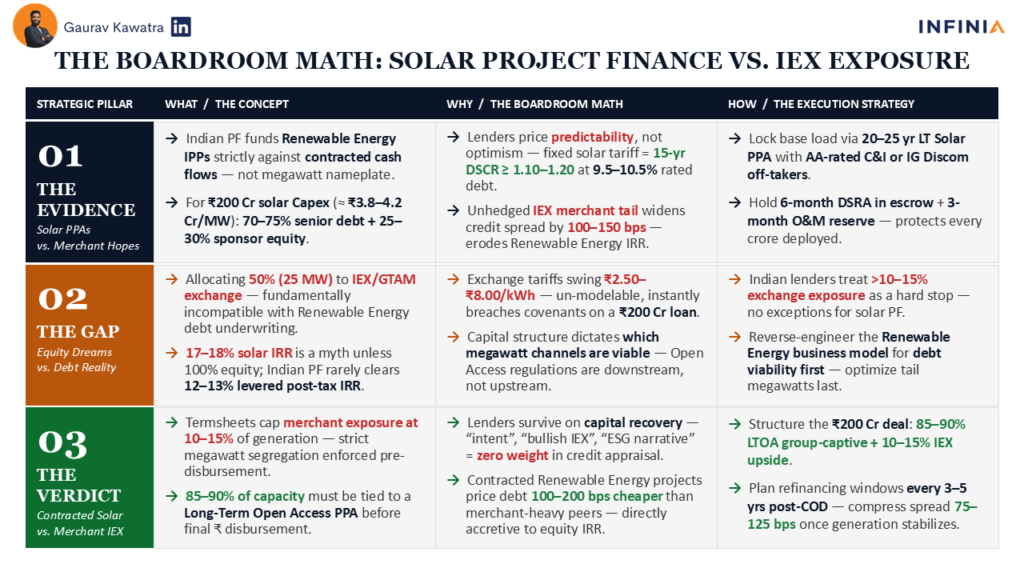
The biggest mistake founders make is letting regulations dictate their strategy. Regulations are merely the boundaries; the Business Model is the engine.
The moment you realize that project finance requires a balance between long-term stability and short-term exposure, you stop reading regulations and start working backward from the math. You must build a power sale strategy that a lender can actually sign off on—one that recognizes that a “peaceful night” with a secured 12% return is infinitely more valuable than a 18% “hope” that fails at the first credit hurdle.
The Boardroom Framework
Before you chase merchant upside, you must stress-test your capital structure. Do not walk into a boardroom with a base-case scenario that ignores the realities of the debt market.
If your company is evaluating a large-scale Renewable Energy project and you want to move from “exchange delusions” to a mathematically unassailable asset:
In this session, we will audit your exact Boardroom Math and power sale strategy to ensure your project is bankable, realistic, and ready for execution.
About Infinia Solar
Infinia Solar is India’s leading renewable energy consultant.
We help Commercial and Industrial consumers procure the right renewable energy solutions, from the right developers, and on the right PPA terms.
We’ve served 60+ customers across 18 states, enabling 1.4 GW of open access and rooftop solar capacity, and have facilitated 150+ PPAs so far.
This has helped our customers reduce up to 50% of their electricity costs and replace up to 100% of their power with renewable energy.
We have also collaborated with 50+ developers, and our customers fondly refer to us as the ‘Amazon of the renewable energy industry.‘