
Executive Summary
For years, Group Captive has been the most attractive Open Access structure available to Commercial & Industrial (C&I) consumers in India. The paper returns were undeniable: ₹3 per unit savings over DISCOM tariffs and an IRR exceeding 19%. Yet, when presented to the Board, these projects were frequently paused or outright rejected. The Board didn’t doubt the savings; they feared the unquantifiable regulatory risk of retroactive Cross-Subsidy Surcharges (CSS).
On March 13, 2026, the Ministry of Power fundamentally altered this landscape. By notifying the Electricity (Amendment) Rules, 2026, the government dismantled the structural barriers that were blocking final capital approvals. We decoded the five major regulatory shifts that transformed Group Captive risk from an “unquantifiable threat” into a “bounded, calculable, and approvable” boardroom strategy.
Here is the exact anatomy of the new regulatory framework.
The Setup: The “No-Brainer” Returns
When a CFO evaluates a renewable energy transition, Group Captive historically presented the strongest financial fundamentals. The structure routinely delivered:
- Massive Cost Reduction: Flat ₹3 per unit saving over existing DISCOM tariffs.
- Capital Efficiency: An IRR above 19%.
- ESG Compliance: The ability to meet over 70% of corporate renewable energy goals through a single, centralized structure.
That is why it flourished, and why executive teams across India kept coming back to it. The fundamentals were never the problem. The roadblock was entirely regulatory.
The Reality Check: The Unquantifiable Trap
A high-level spreadsheet showing an 19% IRR means nothing to a Board if a hidden compliance failure could wipe out the entire financial year’s savings.
Before March 2026, three massive structural barriers were blocking final decisions:
1. The Multi-Entity Flaw: Corporate groups with multiple subsidiaries were forced to meet the 26% ownership and 51% consumption tests individually. A holding company and its subsidiaries could collectively own 40% of a project, yet still be disqualified because the entities were judged in isolation.
2. The Uncapped CSS Nightmare: Proportionate consumption had no ceiling. If just one member of a Group Captive over-consumed beyond their precise ratio, it triggered severe Cross-Subsidy Surcharges (CSS) of ₹0.50 to ₹1.80 per unit. Worse, this penalty was applied retroactively for the entire financial year. It was uncapped and unprovisionable.
3. The Verification Void: The verification process lacked a defined framework. CSS penalties could land on a company’s balance sheet without warning and without a clear mechanism for appeal.
The Board’s objection was entirely justified: “We cannot approve this because the Group Captive risk is unquantifiable.”
The Regulatory Reset: Decoding the 5 Key Amendments
The Ministry of Power’s new Electricity (Amendment) Rules, 2026, act as a structural reset. They directly address and neutralize the Board’s greatest fears, giving C&I consumers the confidence to execute these projects today.
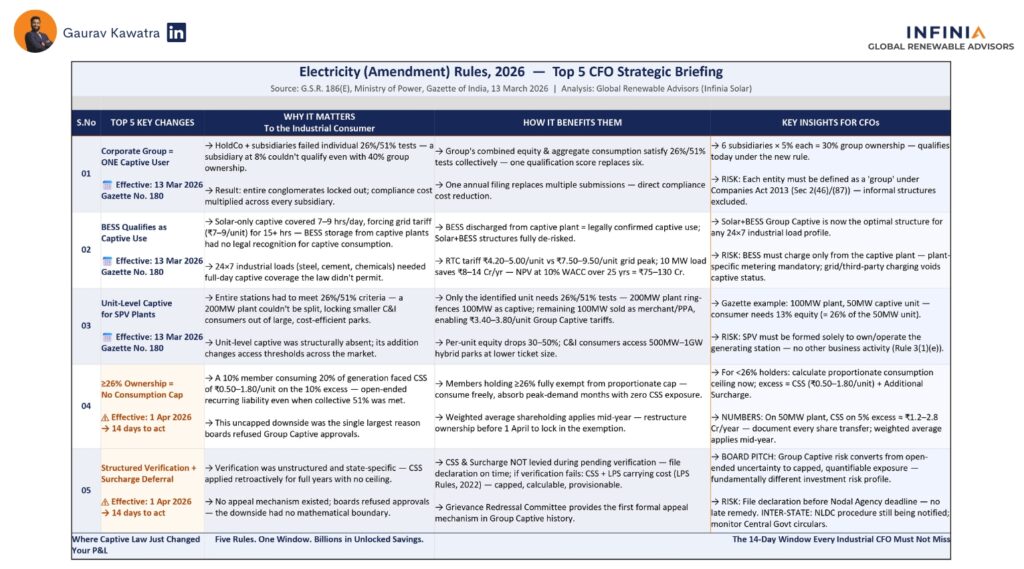
Here are the five critical changes every CFO must know:
- Corporate Group = One Captive User: The fragmented entity risk is gone. HoldCos, subsidiaries, and sister entities are now evaluated under one combined test. You receive one collective compliance score.
- Zero CSS Exposure (The ≥26% Rule): This is the ultimate shield. If your group maintains ≥26% ownership, you are fully exempt from the proportionate consumption cap. The retroactive CSS penalty risk drops to zero.
- BESS Confirmed for Captive Use: Solar and Battery Energy Storage System (BESS) hybrid structures are now officially recognized and fully de-risked to serve 24×7 continuous industrial loads.
- Unit-Level Carve-Outs Confirmed: Unit-level carve-outs are now legally confirmed for SPV plants, meaning your specific manufacturing unit qualifies independently without cross-contamination of risk.
- Defined Verification Process: Verification is now strictly defined (State Nodal Agency for intra-state; NLDC for inter-state). Most importantly, CSS is legally deferred during pending verification, subject to declaration. No more sudden, unappealable penalties.
The Verdict: Ownership of Returns
The narrative in the boardroom has officially changed.
You no longer have to defend a structure filled with regulatory landmines. By leveraging the new MoP rules, the risk profile of a Group Captive project shifts dramatically.
The old boardroom conversation was: “The risk is unquantifiable.” The new boardroom conversation is: “The risk is bounded, calculable, and approvable.”
With the threat of retroactive, uncapped CSS removed, the ₹3 per unit savings and 19% IRR are no longer just paper projections, they are secure, bankable returns.
Next Steps for the Boardroom
If you are an industrial consumer who previously paused or rejected a Group Captive Open Access project due to regulatory fears, the ceiling is now gone. Standard “savings” models are not enough; you need a compliance-backed strategy built on the new 2026 framework.
If you want us to run a Techno-Commercial Wealth Audit for your manufacturing plant and build the legally bulletproof “one slide” your Board needs to see to approve this transition, connect with us to reserve your strategy session today.
About Infinia Solar
Infinia Solar is India’s leading renewable energy consultant.
We help Commercial and Industrial consumers procure the right renewable energy solutions, from the right developers, and on the right PPA terms.
We’ve served 60+ customers across 18 states, enabling 1.4 GW of open access and rooftop solar capacity, and have facilitated 150+ PPAs so far.
This has helped our customers reduce up to 50% of their electricity costs and replace up to 100% of their power with renewable energy.
We have also collaborated with 50+ developers, and our customers fondly refer to us as the ‘Amazon of the renewable energy industry.‘