
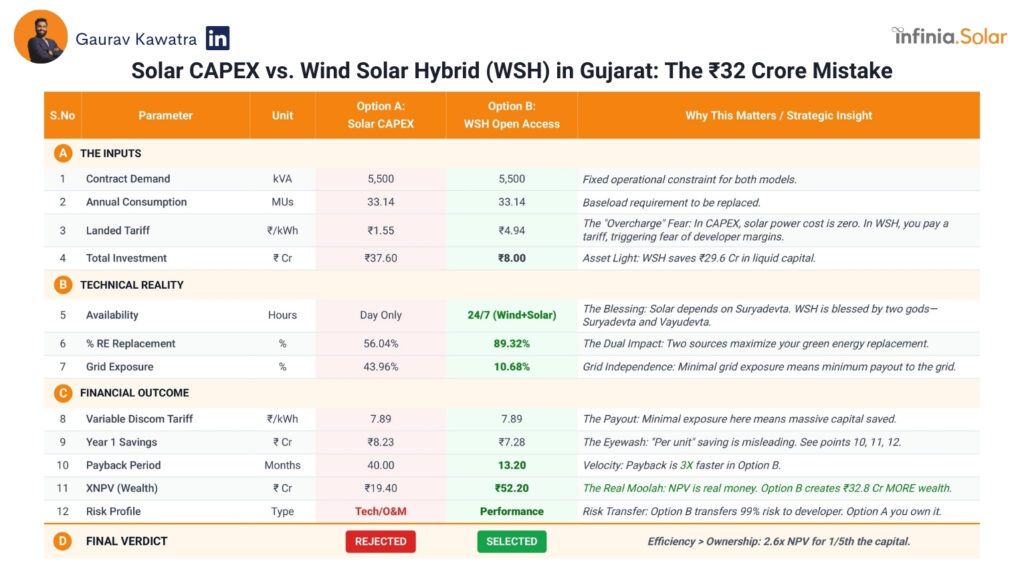
Solar CAPEX at ₹1.55 vs Wind-Solar Hybrid at ₹4.94 in Gujarat.
Why I stopped a Pharma CFO from making a ₹32 Crore mistake.
It sounds like a Financial Disaster.
I told the CFO of a Gujarat-based Pharma giant that his plan to sign a Solar CAPEX deal at ₹1.55/kWh was a trap. On paper, it looked like a win. In reality, he was about to make a ₹32 Crore mistake.
The Scenario: 33 Million Units and an Ultimatum
The company was consuming 33 Million units yearly, burning a ₹30 Crore electricity bill. The Board mandated the CFO to execute a 30% cost cut, but the stakes were much higher:
The Export Threat: They export heavily to the US and Europe. Their products were facing rejection because they were not produced from Green Power.
The ESG Pressure: Being a listed company, they had to maintain strict ESG compliance.
The Delisting Fear: Their biggest customers gave an ultimatum—debarring and delisting them unless they switched to green energy.
The pressure was immense. He had to prove his worth. He reached out to 6 developers and finally shortlisted two options:
Developer A (Solar CAPEX):
- Landed Tariff: ₹1.55/kWh
- Investment: ₹37.6 Cr
Developer B (Wind-Solar Hybrid Open Access):
- Landed Tariff: ₹4.94/kWh
- Investment: ₹8.0 Cr
The CFO was ready to sign with Developer A. 100% lifetime ownership felt like a massive win. But one apprehension remained: “Why the ₹3+ tariff gap? Is Developer B overcharging me?”
The Forensic Analysis: Ownership vs. Sanity
To prove his decision to the Board, he asked us for a forensic Techno-Commercial Analysis. I told him: “Do not own this asset. Ownership is vanity. Efficiency is sanity.”
Here is why the reality flipped:
1/ The Solar CAPEX Trap The “Per unit” savings is a dangerous illusion. You invest ₹37.6 Cr but rely only on Suryadevta. The plant sits idle 14 hours. You carry 100% operational risk, replace only 56% of grid power, and fail the export mandate.
2/ Wind-Solar Hybrid Open Access You invest just ₹8.0 Cr. You are backed by the Dual Blessing of Suryadevta and Vayudevta. Wind fills the night gap. 99% of performance risk passes to the developer. You replace a massive 89% of grid power and secure your international buyers.
The Verdict: The Real Moolah
The “Expensive” Hybrid model delivered the wealth. While Solar CAPEX had a 40-month payback and ₹19.4 Cr NPV, the Wind-Solar Hybrid dropped the payback to 13 months and jumped the NPV to ₹52.2 Cr.
By “saving” on the tariff, the CFO almost threw away ₹32.8 Crores in lifetime wealth. He went to the Board with the Hybrid option, and they approved it unanimously.
Conclusion: Ownership is a trap if it kills your capital efficiency. How much money the business makes (NPV) is the only metric that matters.