
Executive Summary
A Tamil Nadu-based steel manufacturer with a 50 MVA Contract Demand was bleeding margins through a massive ₹256.8 Crore annual electricity bill. Facing European export bans on “Black Power” and aggressive ESG demands from investors, the CFO was mandated to switch to Renewable Energy. He was 24 hours away from signing a “cheap” Solar deal at ₹4.03/unit because the paper returns looked unbeatable.
We intervened. By running a Techno-Commercial Audit under the strict new Tamil Nadu Green Energy Open Access (GOA) regulations, we exposed the “L1” trap. We forced the CFO to reject the lowest bid, pay a higher tariff of ₹4.44/unit for a Wind-Solar Hybrid system, and invest ₹19.95 Crore more upfront. The result? He successfully bypassed the death of night-time banking, drove RE replacement from 43.31% to 61.67%, and secured an additional ₹135.5 Crores in wealth (NPV) for the company.
Here is the exact boardroom breakdown of how we did it.
The ₹256.8 Crore Mandate: A Crisis of Competitiveness
For a continuous-process industry like steel, power is not just an operational cost; it is the ultimate margin dictator. This specific CFO was managing three manufacturing plants in Tamil Nadu, consuming a staggering 29.89 Crore units per annum.
While his facilities were paying a ₹256.8 Crore grid bill, his competitors had already transitioned to Open Access Renewable Energy and were paying 30% less. But the pressure was not just domestic:
- The Export Threat: The company exports heavily to European markets. With Europe actively moving to ban steel manufactured using carbon-heavy “Black Power,” the company’s entire export revenue was at immediate risk.
- Investor Pressure: As a listed entity, institutional investors were strictly demanding ESG compliance and a verifiable reduction in Scope 2 emissions.
The mandate from the Board was clear and urgent: Reduce the ₹256.8 Crore Opex and switch to maximum Renewable Energy immediately.
The “No-Brainer” Shortlist: The L1 Trap
The CFO scouted the market and shortlisted two prominent developers. When the proposals landed on his desk, the financial optics heavily favored the cheapest option.
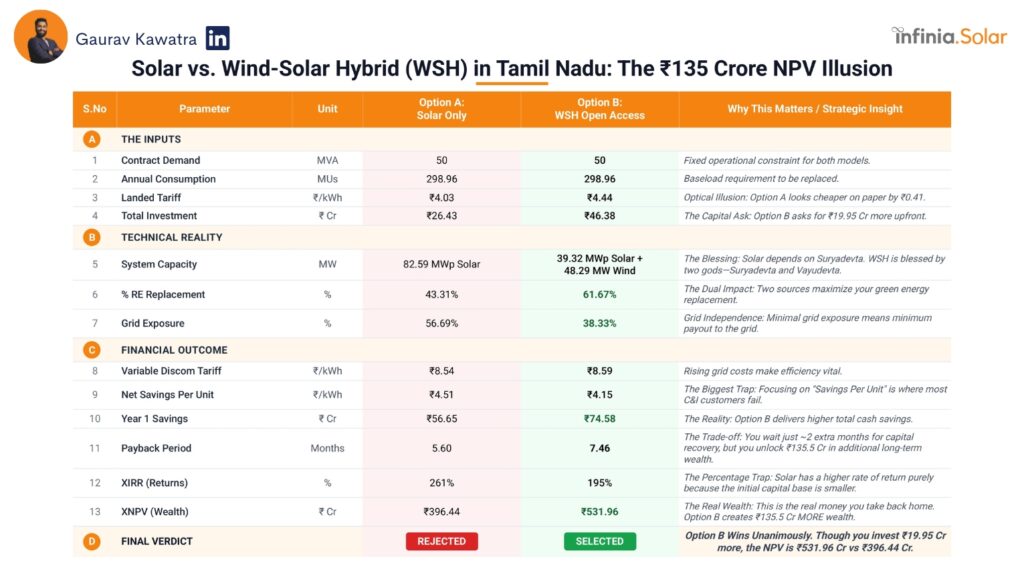
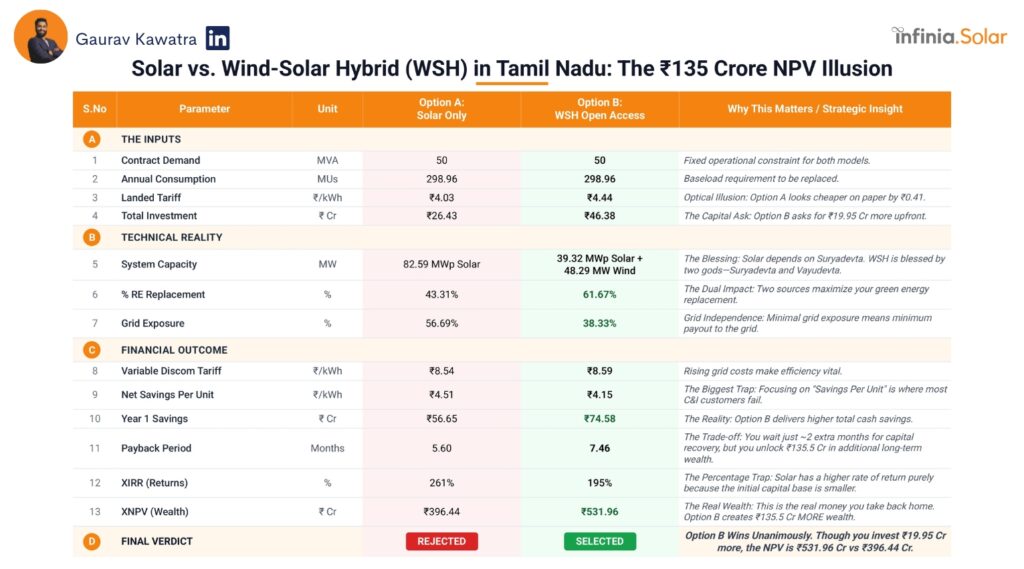
Developer 1 (Solar Only)
- Tariff: ₹4.03/unit
- Savings: ₹4.51/unit
- Equity Investment: ₹26.43 Cr
- XIRR: 261%
Developer 2 (Wind-Solar Hybrid)
- Tariff: ₹4.44/unit
- Savings: ₹4.15/unit
- Equity Investment: ₹46.38 Cr (An extra ₹19.95 Cr upfront)
- XIRR: 195%
For a CFO tasked with cutting costs, signing with Developer 1 was a standard “no-brainer.” The attractive savings per unit and the massive 261% XIRR looked like a definitive win on a spreadsheet.
But before taking this to the Board for final capital approval, he needed absolute certainty. He reached out to us to validate the long-term relationship and verify if this proposal would actually meet his aggressive RE replacement goals.
The Reality Check: The Death of Night-Time Banking
We ran the proposals through our Techno-Commercial Audit, specifically stress-testing them against the new Tamil Nadu Green Energy Open Access (GOA) regulations.
When you look past the basic tariff, the new TN GOA rule reveals a strict, non-negotiable reality: Night-time banking is dead. You are legally prohibited from banking solar power generated during the day and settling it against power consumed at night.
For a steel plant running massive, energy-intensive night shifts, this regulatory shift changes the entire financial model.
The Forensic Audit: Why “Cheap” Solar was Financial Suicide
By mapping the plant’s 15-minute load profile against the generation curves of both developers, we exposed the massive wealth gap hidden in the regulatory fine print.
Developer 1 (The “Cheaper” Trap) Because standard solar only generates during the day, the steel plant’s massive night-shift loads were left completely unhedged. The 261% XIRR was an optical illusion based on outdated banking assumptions.
- Actual Replacement: Capped at a mere 43.31%.
- Net Present Value (Wealth): ₹396.4 Crore.
- The Verdict: The night shifts were left completely exposed to inflating grid rates, severely failing the Board’s mandate to maximize RE.
Developer 2 (The Hybrid Solution) The Wind-Solar Hybrid system fundamentally solved the regulatory problem. Because wind generation extends into the evening and night, it perfectly covered the night shifts, completely bypassing the restrictive daytime settlement rules.
- Actual Replacement: Jumps to 61.67%.
- Net Present Value (Wealth): ₹531.9 Crore.
The Verdict: Ownership of Returns
This data completely changed the CFO’s mindset. The decision was no longer about minimizing the per-unit tariff; it was about maximizing the total capital replaced.
By strategically choosing to pay the ₹0.41/unit premium and investing the extra ₹19.95 Crore upfront, the CFO secured an additional ₹135.5 Crores in wealth for the company.
The mathematical truth is undeniable: More Replacement = More NPV.
He went to the Board with this exact Techno-Commercial framework. He didn’t just present a spreadsheet; he presented a risk-mitigated strategy that secured their European export lines and delivered maximum ESG compliance. The Board approved the higher capital expenditure unanimously.
Don’t buy a Tariff. Buy Returns.
Next Steps for the Boardroom If you are an industrial consumer in Tamil Nadu running continuous night shifts, standard daytime solar calculations are obsolete. You need a forensic analysis of your load profile against the TN GOA settlement rules.
If you want us to run a Techno-Commercial Wealth Audit based on this strict framework for your manufacturing plant, connect with us to reserve your boardroom strategy session today.
Follow Gaurav Kawatra for boardroom-level clarity and unfiltered renewable energy truths.
About Infinia Solar
Infinia Solar is India’s leading renewable energy consultant.
We help Commercial and Industrial consumers procure the right renewable energy solutions, from the right developers, and on the right PPA terms.
We’ve served 60+ customers across 18 states, enabling 1.4 GW of open access and rooftop solar capacity, and have facilitated 150+ PPAs so far.
This has helped our customers reduce up to 50% of their electricity costs and replace up to 100% of their power with renewable energy.
We have also collaborated with 50+ developers, and our customers fondly refer to us as the ‘Amazon of the renewable energy industry.‘