
The L1 Trap: Why I Forced a CFO to Pay ₹0.34 EXTRA Per Unit (And Invest ₹35 Lakhs MORE)
“It sounds like Financial Suicide.”
That is exactly what the CFO of a leading Automotive Company in Rajasthan told me last week.
He was holding two proposals in his hand. One offered Solar at ₹3.60. The other offered Solar at ₹3.94.
He asked me: “Gaurav, why on earth would I pay ₹0.34 EXTRA per unit and invest ₹35 Lakhs MORE upfront? The Board will laugh at me.”
I looked at him and said: “If you sign the cheaper one, you aren’t saving money. You are burning ₹6.2 Crores of future wealth.”
Here is the story of how we turned an “Expensive” proposal into a 2.7x Wealth Multiplier.
The Crisis: The “Blacklist” Threat
This wasn’t just about saving money on electricity. It was about survival.
- The Burn: The plant was consuming 7.99 Million units from the Grid, burning ₹5.99 Cr annually.
- The Mandate: The Global Vendors had issued a warning—switch to 75% Renewable Energy by 2027 or risk being Blacklisted.
- The Pressure: He needed to cut costs by 30% immediately.
He shortlisted two developers. On paper, the choice looked obvious.
The Optical Illusion: L1 (Cheap) vs. L2 (Expensive)
Developer 1 (The “Cheap” Choice):
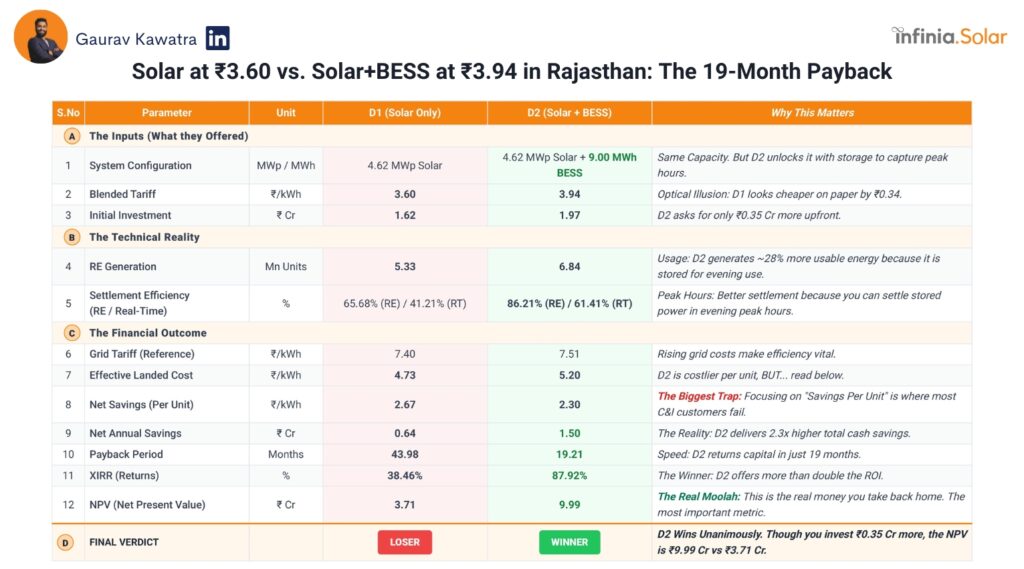
- Tariff: ₹3.60 / unit
- Initial Investment: ₹1.62 Cr
- The Hook: It required the least capital and offered the lowest tariff.
Developer 2 (The “Expensive” Choice):
- Tariff: ₹3.94 / unit (Solar + BESS)
- Initial Investment: ₹1.97 Cr
- The Snag: It demanded ₹35 Lakhs more upfront and a higher unit rate.
Most CFOs stop here. They sign Developer 1. They celebrate the “Savings.” But we didn’t stop. We ran the Techno-Commercial Audit.
The Technical Reality: Efficiency vs. Ego
We asked one dangerous question: “Will the Cheaper Solution actually hit your 75% Target?”
The answer was a resounding NO.
The Audit of Developer 1 (Solar Only):
- Generation: 5.33 Million Units.
- Settlement Efficiency: Only 65.68%.
- Real-Time Replacement: A poor 41.21%.
- The Failure: You miss the Global Vendor mandate. You stay in the “Danger Zone.”
The Audit of Developer 2 (Solar + BESS):
- Generation: 6.84 Million Units (Thanks to 9 MWh Battery Storage).
- Settlement Efficiency: Jumps to 86.21% because you capture peak hours.
- Real-Time Replacement: 61.41%.
- The Win: You smash the target and future-proof the factory.
The Financial Verdict: Buying Wealth, Not Power
Then, we looked at the money. This is where the “L1 Trap” collapsed.
We compared the Net Present Value (NPV)—the actual wealth created over the project’s life.
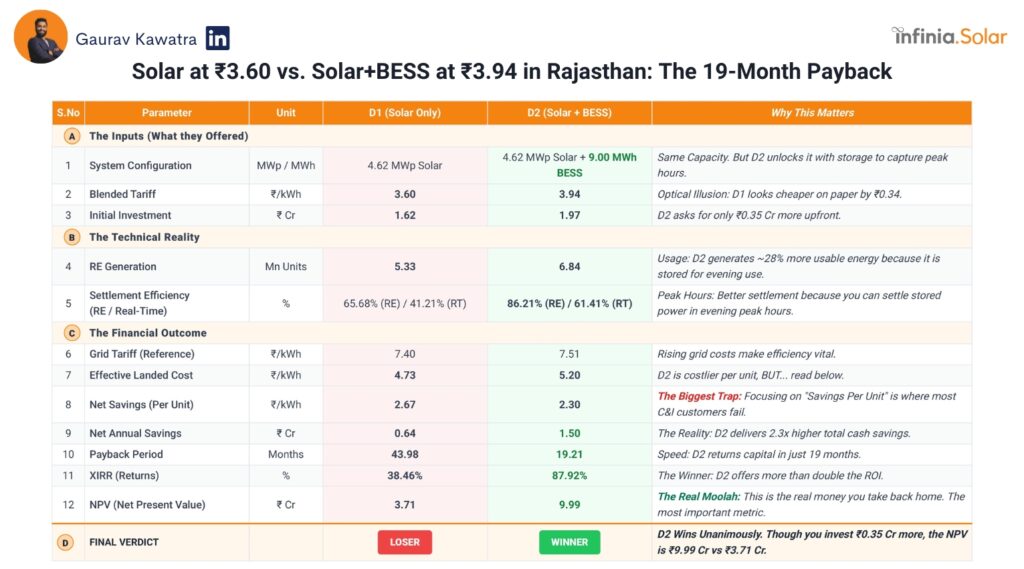
- Developer 1 (Cheap): Generated ₹3.71 Cr in wealth. Payback took 44 Months.
- Developer 2 (Expensive): Generated ₹9.99 Cr in wealth. Payback dropped to 19.2 Months.
Read that again.
By investing just ₹35 Lakhs more upfront, the company unlocked ₹6.2 Crores in additional profit. The “Expensive” project paid for itself twice as fast (19 months vs. 44 months).
The Boardroom Approval
The CFO went to the Board with these exact numbers. He didn’t pitch “Solar Panels.” He pitched Capital Efficiency.
- The ROI: 87.92% XIRR (vs 38.46%).
- The Payback: Less than 2 years.
- The Compliance: 100% Safe from Blacklisting.
The Board approved the “Higher Tariff” and the “Higher Investment” unanimously.
The Lesson
In Renewable Energy, “L1” (The Lowest Bidder) is often a trap. A lower tariff that delivers less power is not a saving; it is an opportunity cost.
Don’t let the “Optical Illusion” of a cheap unit rate blind you to the reality of Net Wealth.
Do you have multiple proposals on your table right now? Are you about to sign L1 because it “looks” cheaper?
[Download the Exact Techno-Commercial Framework Here]
Use this framework to stress-test your bidders.
Let’s ensure you are buying an Asset, not just a Liability.
Gaurav Kawatra Founder & Director, Infinia Solar