
Executive Summary
A Tamil Nadu-based pharmaceutical manufacturer was evaluating a 15 MW Wind-Solar Hybrid solution. Despite the project promising a massive 70% energy replacement, an 80% IRR, and strong xNPV, the ₹100 Crore+ capital expenditure hit a wall in the boardroom. The sticking point? The tariff. With standalone Solar available at ₹3.0–3.5/unit, the Board questioned the logic of paying a ₹3.80/unit premium for a Hybrid model.
We intervened to shift the executive mindset away from the “illusion of cheap power.” By mapping out a sharp, boardroom-ready comparison of Wind vs. Solar vs. Hybrid, we proved that the lowest tariff does not equal the highest wealth creation. The result? The Board abandoned the race for the cheapest unit and unanimously approved the strategy that delivered predictable, dependable, high-replacement power.
Here is the exact boardroom breakdown of how we navigated the tariff trap.
The ₹100 Crore Mandate: A Crisis of Capital Allocation
For a major pharmaceutical company, energy reliability is just as critical as cost reduction. The company had aggressive ESG goals to hit and needed a Renewable Energy strategy that would drastically reduce its reliance on the grid.
The proposed 15 MW Wind-Solar Hybrid solution was engineered to deliver exactly what they needed:
- Energy Replacement: 70% of total consumption.
- Return on Investment: 80% IRR.
- Wealth Creation: Strong xNPV to secure long-term financial stability.
But the moment the ₹3.80/unit tariff was presented, the entire room leaned in. In the C-suite, this is exactly where every ₹100 Cr+ Renewable Energy discussion begins—and where it usually gets stuck.
The Tariff Trap: The Boardroom Interrogation
When executives see a cheaper alternative on the market, paying a premium feels counterintuitive. Before the presentation could proceed, the Board launched a barrage of sharp, highly technical questions aimed at dismantling the Hybrid proposal:
1. The “Cheap Solar” Argument: “Solar is ₹3.0–3.5/unit… then why should we buy a Wind-Solar Hybrid at ₹3.80?”
2. The “High CUF Wind” Argument: “Wind gives 29–39% CUF. Solar doesn’t cross 23–24%. If we want more power, shouldn’t Wind win on its own?”
3. The “Timeline and Risk” Argument: “Solar gets commissioned in 6–9 months. Wind takes 15–18 months. Why wait? Furthermore, Solar is stable, while Wind generation is volatile. Isn’t that an unnecessary risk?”
The ultimate question was simple: “Why Hybrid? Why not pick the absolute cheapest, or the highest CUF?”
The Forensic Audit: Why “Cheap” Power Loses in the Boardroom
These are the exact questions every Board asks before approving massive capital allocations. If you defend a project based on tariff alone, you will lose the room.
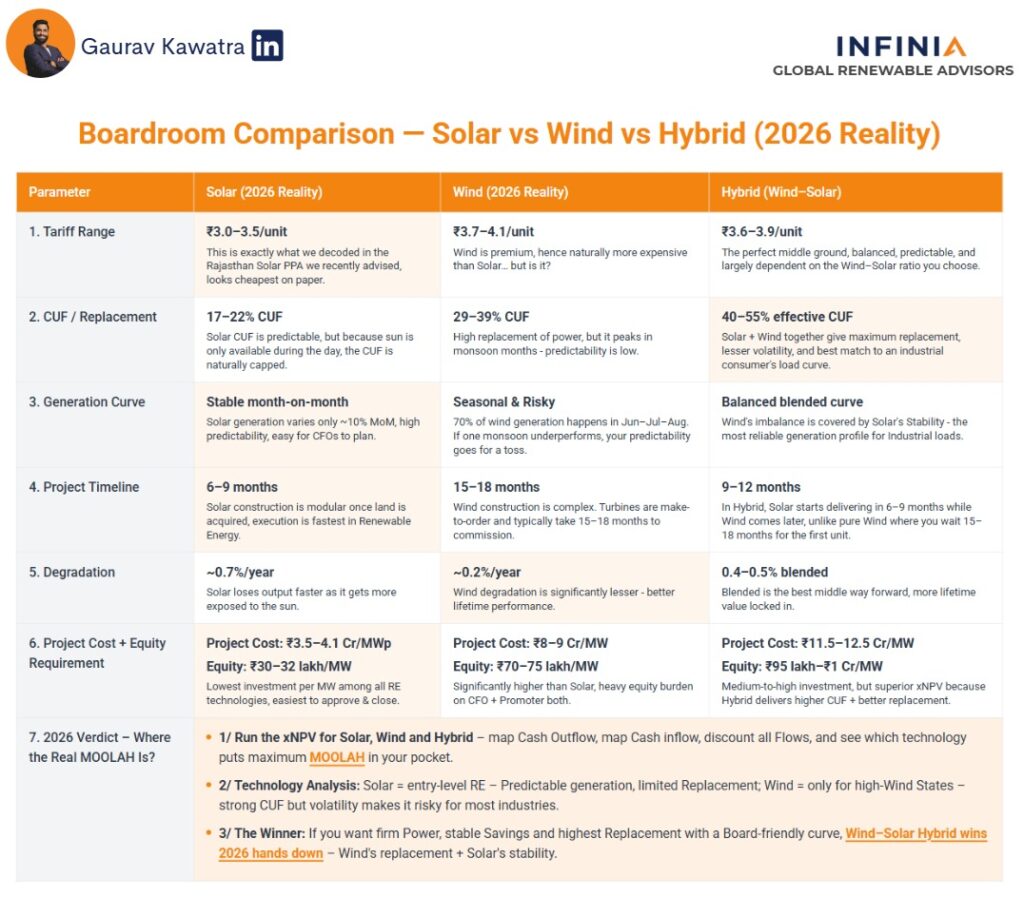
We walked in with a sharper, Boardroom-ready framework. We completely bypassed the “cost per unit” debate and instead ran a forensic comparison across the metrics that actually drive corporate wealth:
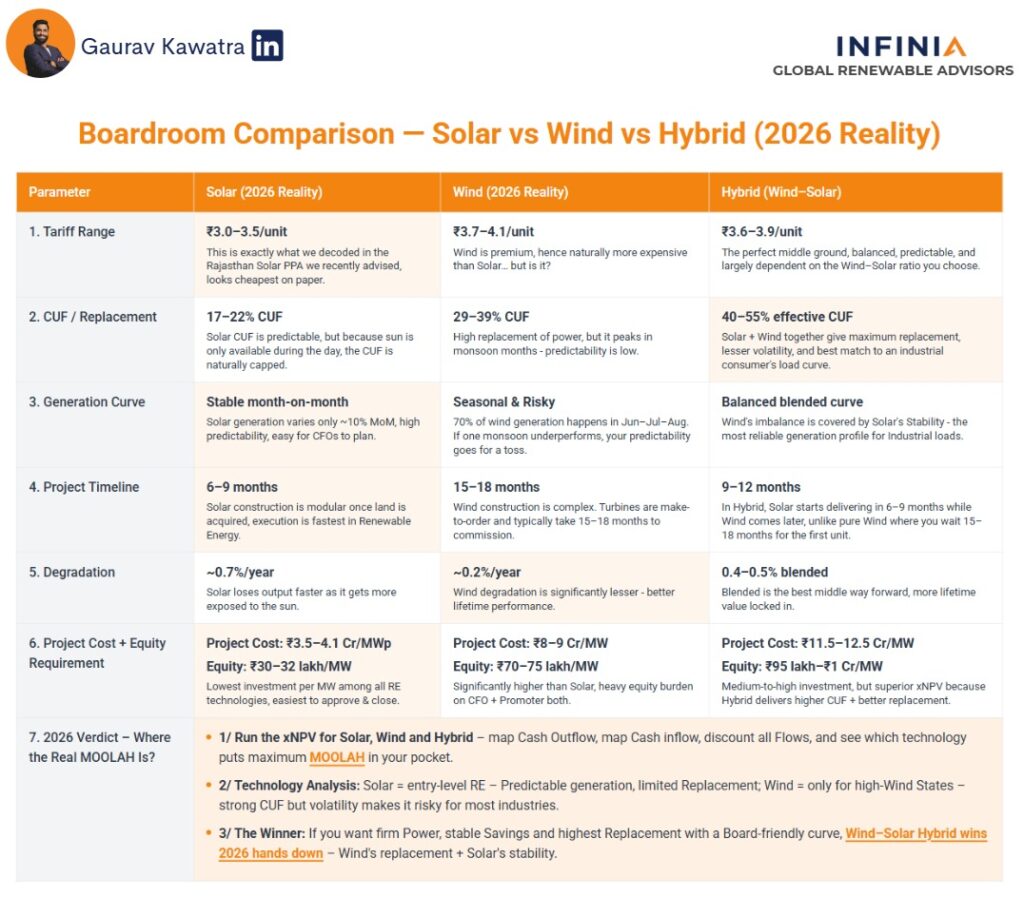
- Tariff vs. Replacement %: Standalone solar might be cheap, but it caps out at replacing 24% of the load. A ₹3.80 Hybrid system drives replacement to 70%, shielding a massively larger portion of the company’s operations from inflating grid costs.
- Volatility vs. Predictability: While wind is volatile on its own, combining it with solar creates a blended curve that perfectly maps to continuous industrial operations.
- Timelines vs. xNPV: A faster solar commissioning time looks great in Year 1, but over a 25-year lifecycle, the superior xNPV of a Hybrid system mathematically obliterates the short-term gains of a quick solar install.
The Verdict: Ownership of Returns
This transparency completely changed the Board’s perspective. We distilled Tariff, CUF, predictability, degradation, timelines, replacement %, and xNPV into one undeniable truth:
Cheap power doesn’t win Boardrooms. Predictable, dependable, high-replacement power does.
By strategically choosing to pay the premium for the Hybrid system, the Board secured maximum replacement and maximum wealth (xNPV). The decision was no longer about minimizing the per-unit cost; it was about maximizing the total capital replaced. The Board approved the ₹100 Cr+ investment unanimously.
Don’t buy a Tariff. Buy Returns.
Next Steps for the Boardroom
If you are an industrial consumer in Tamil Nadu looking to present a Wind-Solar PPA for approval, standard “savings” projections are not enough. You need a forensic analysis of your landed cost against the current TN Open Access settlement rules.
If you want us to run a Techno-Commercial Wealth Audit for your plant and build the “one slide” your Board needs to see, connect with us to reserve your strategy session today.
About Infinia Solar
Infinia Solar is India’s leading renewable energy consultant.
We help Commercial and Industrial consumers procure the right renewable energy solutions, from the right developers, and on the right PPA terms.
We’ve served 60+ customers across 18 states, enabling 1.4 GW of open access and rooftop solar capacity, and have facilitated 150+ PPAs so far.
This has helped our customers reduce up to 50% of their electricity costs and replace up to 100% of their power with renewable energy.
We have also collaborated with 50+ developers, and our customers fondly refer to us as the ‘Amazon of the renewable energy industry.‘