
Executive Summary
A major automotive company was planning to expand its manufacturing base across Maharashtra, Haryana, or Rajasthan. Having already achieved massive returns in their existing plants, the Board delivered a clear mandate: hit at least 77% Renewable Energy replacement, scale to 100% over the next 3 years, and secure more than ₹2 per unit saving. The target state had to be resource-rich in solar, wind, and storage. But the CFO knew the ground reality: resource potential is not enough. This post breaks down how we decoded the 6 critical state regulations that dictate savings, IRR, and investment, enabling the CFO to confidently shortlist the exact state for the new plant.
The Setup: The Board’s Mandate
The CFO of an automotive company had already procured 10 MW wind-solar solutions for their Tamil Nadu and Gujarat plants.
They were enjoying massive returns:
→ 77% replacement through Renewable Energy.
→ ₹2.2 per unit average savings vs. the grid.
→ 77.8% Equity IRR.
The CFO was applauded internally by the Board for achieving this.
Now, the company wanted to expand their manufacturing base. They were exploring options like Maharashtra, Haryana, and Rajasthan. The Board and the investors gave a clear mandate to the CFO:
“We will only shortlist a state where we can hit at least 77% RE replacement, scaling to 100% over the next 3 years, with more than ₹2 per unit saving.”
The state had to be resource-rich in solar, wind, and storage.
The Constraint: The Regulatory Bottleneck
But the CFO knew the ground reality.
One of the biggest triggers—and the most critical metric to study to meet the Board’s objective—is the state’s regulations.
He was confused and wanted clarity. Within the regulations, what are the top things he should look at? → What are these parameters?
→ Why does each matter?
→ Where do you find these regulations?
→ What is the exact impact on savings, IRR, and investment?
He reached out to us.
The Verdict: The 6-Parameter Framework
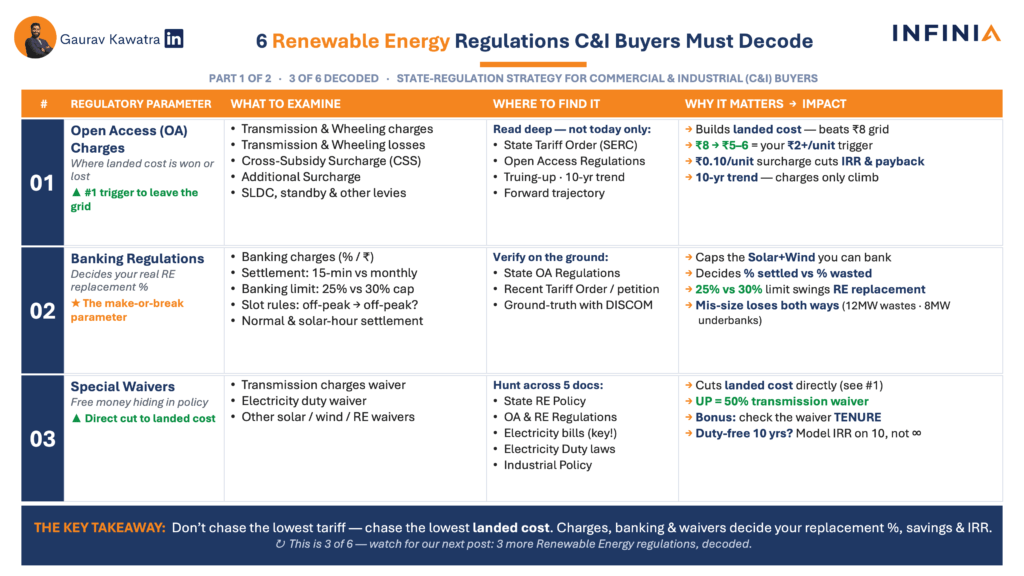
We decoded the 6 things that any commercial and industrial consumer must evaluate while studying state regulations.
Because it is detailed, we break it down into the most critical parameters. Here are 3 of the 6 critical regulations you must evaluate:
- Open Access Charges
- Banking Regulations
- Special Waivers
The CFO studied all these parameters. He went back to the Board and finally shortlisted the exact state between Maharashtra, Haryana, and Rajasthan to set up the new plant.
The Lesson for every CXO: Regulations Over Resources
A state that is resource-rich in solar, wind, and storage is useless if you do not understand the exact impact of its regulations on your savings, IRR, and investment.
Do not sign your term sheet without clarity. If your company is evaluating an Open Access project, you must study these critical metrics to meet your Board’s objective.
In this session, my team and I will run a detailed audit of your project’s financial model, stress-test your strategy against state regulations, and deliver a Board-ready framework to ensure your energy strategy is mathematically unassailable.
About Infinia Solar
Infinia Solar is India’s leading renewable energy consultant.
We help Commercial and Industrial consumers procure the right renewable energy solutions, from the right developers, and on the right PPA terms.
We’ve served 60+ customers across 18 states, enabling 1.4 GW of open access and rooftop solar capacity, and have facilitated 150+ PPAs so far.
This has helped our customers reduce up to 50% of their electricity costs and replace up to 100% of their power with renewable energy.
We have also collaborated with 50+ developers, and our customers fondly refer to us as the ‘Amazon of the renewable energy industry.‘