
Executive Summary
Solar at ₹4.70 vs. Solar+BESS at ₹6.58. It sounds like financial suicide. But for a Steel Giant in Maharashtra, the “Cheaper” option was a trap. This post breaks down how we stopped a CFO from signing an L1 tariff that would have failed a strict European export mandate, and how we secured unanimous Board approval for a 24×7 firm power solution instead. Here is the story.
The Setup: The Perfect Bottom Trap
The CFO of a Steel Industry leader was paying a ₹100 Crore electricity bill.
→ Grid Tariff: ₹10 per unit.
→ Consumption: 10 Crore units per annum.
But the real pressure wasn’t just the cost. It was the European Market. Their customers gave an ultimatum: “Go Green, or we stop buying your steel.”
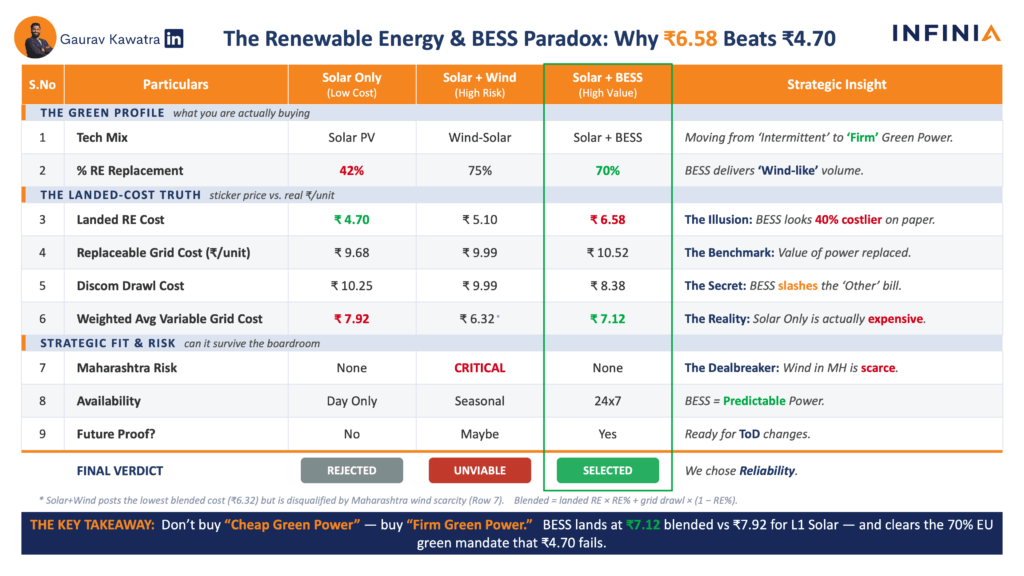
He spent 6 months scouting the market to solve this. After negotiating with every developer, he shortlisted 3 scenarios: 1/ Solar Only: ₹4.70 tariff (42% Replacement) 2/ Solar + Wind: ₹5.10 tariff (75% Replacement) 3/ Solar + BESS: ₹6.58 tariff (70% Replacement)
He was about to walk into the Boardroom to sign the ₹4.70 tariff. It was the cheapest. It was “L1”.It looked like a win.
But his team hesitated.
They called us for a final check: “Gaurav, shall we go ahead and sign the Solar deal? It is the cheapest one.”
I looked at the data and stopped him.
The Constraint: The European Export Mandate
We decoded the numbers, and the outcome was starkly opposite.
The “Cheap” Trap (Solar @ ₹4.70): It only gives 42% replacement. You still depend on the Grid for 58% of your power (paying ₹10/unit). Result: You fail the European export mandate.
The “Winner” (Solar + BESS @ ₹6.58): Yes, the tariff is higher. But it gives 70% replacement with 24×7 firm power. No dependence on wind seasonality. No Grid exposure during peak hours.
The Verdict: Firm Power vs. Cheap Tariffs
We proved that Solar+BESS, even at a higher initial tariff, was the only mathematically viable solution.
European mandates do not care about your local “L1” savings; they care about round-the-clock green compliance. If you rely on the grid for 58% of your power, your steel is still classified as carbon-heavy. You are essentially paying a shadow carbon tax that wipes out any minor savings you made on the solar tariff.
By looking at the true constraints, the CFO realized his “cheap” tariff was actually a massive liability. He stopped chasing L1, bypassed standard procurement logic, and went directly to the Board with our matrix to secure unanimous approval for the Solar+BESS solution.
The Lesson for every CXO: Macro-Risk Over Micro-Discounts
A ₹4.70 tariff is mathematically useless if you fail your export mandate while trying to squeeze out a few extra paise in savings.
Do not get trapped in a plain vanilla cost comparison. Procurement teams are trained to buy the cheapest option; Boards are required to mitigate overall business risk. When you are taking a 25-year, multi-crore decision to your Board, you cannot treat a Power Purchase Agreement (PPA) like a standard commodity purchase. You need the macro-data to prove why locking in firm power today is the safest bet for your overall business continuity.
If your company is evaluating an Open Access project, do not sign the term sheet without calculating your true macro constraints—especially if your revenue depends on global ESG mandates.
If you are exporting to Europe, “L1 Tariff” is not a strategy. It is a trap. Don’t buy “Cheap Green Power.” Buy “Firm Green Power.”
In this session, my team and I will decode your exact plant requirements, check which Solar, Wind, or Hybrid solution actually works for your balance sheet, and deliver a Board-ready framework.
About Infinia Solar
Infinia Solar is India’s leading Corporate & IPP Renewable Energy Advisory. We are not developers or manufacturers—we act as the strategic bridge between corporate buyers and developers.
Built by India’s first buy-side RE advisory, we operate with a pure Guardian Mindset: we exist to fiercely protect the corporate’s interest in every single energy decision.
Every PPA negotiation has two sides. Using our proprietary RE MAXX™ methodology, we evaluate 59+ critical clauses in every agreement to ensure our clients sign “Zero Regret Agreements.”
The Portfolio & Impact:
→ 1.6 GW capacity advised
→ 150+ PPAs negotiated with Zero portfolio defaults
→ ₹6,500 Cr+ in executed project value
→ 65+ corporate clients across 19 states and 9 industry sectors
→ ₹500 Cr+ in annual client savings
→ Minimum 5X ROI guaranteed
One Electricity Bill. One Call. Your Savings Estimate in 48 Hours.
Clarity Before You Sign.