
Executive Summary
Transitioning to Open Access Renewable Energy is no longer just a sustainability metric; it is a direct lever for valuation.
Recently, the CFO of a massive Gujarat-based steel manufacturer mapped out a strategy to drop his annual electricity bill from ₹200 Crore down to ₹140 Crore using Open Access Solar and Wind PPAs.
This ₹60 Crore direct jump in EBITDA would instantly increase the company’s market cap, while fully complying with their ESG mandates as a listed entity.
The numbers on the spreadsheet were undeniable. But the Term Sheet remained unsigned.
The roadblock was not a lack of capital or intent. It was the fear of the unknown. When boardroom investors look at a 25-year energy commitment, they do not just see projected returns—they see crippling regulatory risk. Here is the exact mathematical framework we used to dismantle that fear and secure unanimous Board approval.
The Dilemma: The Cost of Fear
During our closed-door meeting, the CFO was brutally honest about his hesitation. He wanted the ₹60 Crore savings, but he was staring down a barrel of variables he could not control.
He told me: “Whenever I start evaluating these solutions, what I see is risk.”
His boardroom was stuck on two highly valid, catastrophic scenarios:
- The Off-Take Trap: What if state policies change tomorrow, and we are legally trapped by a take-or-pay off-take commitment for power we can no longer consume?
- The Surcharge Squeeze: What if new, aggressive open access charges (cross-subsidy surcharges, additional surcharges, transmission losses) are suddenly introduced, wiping out the arbitrage?
These solutions are heavily risk-oriented. Developers push the base-case returns, but corporate boards demand worst-case mitigations. To break the deadlock, the CFO needed a foolproof way to insulate his balance sheet from the regulators.
The Techno-Commercial Mitigation Framework
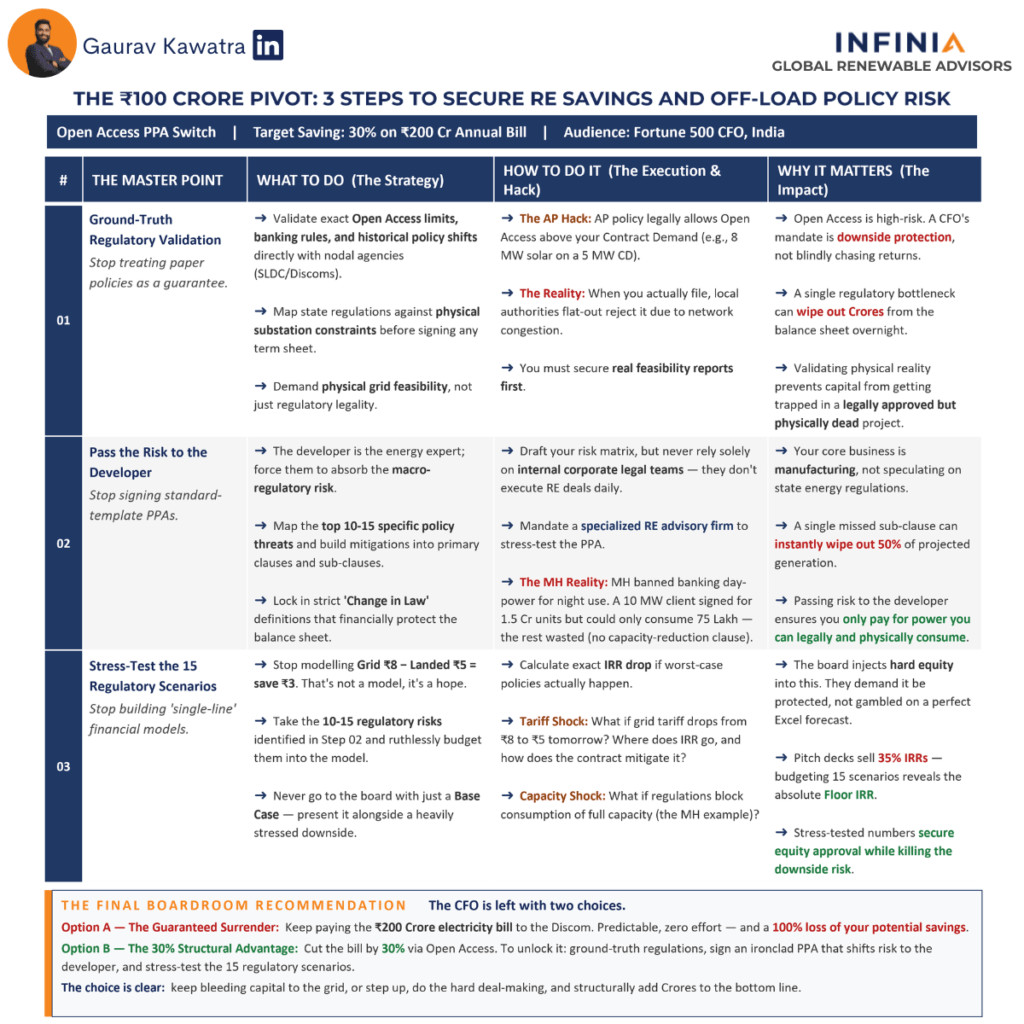
To secure the equity investment, we stopped discussing “returns” and started engineering “risk mitigation.” We deployed a 3-step framework to mathematically kill the regulatory fear:
1. Ground-Truth the Policies
You cannot rely solely on reading the regulatory documents or taking a developer’s word for it. Policies on paper often behave differently in practice.
- The Action: We forensically validated how these specific solar and wind policies were actually executing on the ground in Gujarat in real-time, mapping historical precedents for regulatory rollbacks.
2. Weaponize the PPA and SHA
A standard Power Purchase Agreement (PPA) and Shareholder Agreement (SHA) protects the developer. A buy-side corporate must flip this dynamic.
- The Action: We structured the contractual clauses to specifically pass the regulatory, generation, and operational risks completely back to the developer. If the rules change, the developer’s margins take the hit, not the steel manufacturer.
3. Build the Regulatory Sensitivity Model
Never walk into a boardroom with just a “Base Case” scenario. You must show the Board exactly what happens when things go wrong.
- The Action: We put every single regulatory risk into the financial model. We built 10 brutal, worst-case regulatory scenarios that could erode their capital, and attached the exact contractual mitigation for each one.
The Boardroom Verdict
The CFO took this 3-step framework to the Board.
The investors knew the base case delivered a ₹60 Crore saving. But it was Step 3 that won the room. Seeing the exact financial sensitivities of various regulatory risks—and knowing the PPA was weaponized to defend against them—gave the investors absolute confidence.
They approved the equity investment instantly. The project wasn’t approved because it chased high returns; it was approved because it ruthlessly eliminated risk.
Next Steps for the C-Suite
Stop relying on base-case developer PPT numbers that ignore regulatory reality. If you want to secure a massive EBITDA jump, you must mathematically defend your downside.
If your company is evaluating an Open Access Term Sheet and you want us to run a Techno-Commercial Wealth Audit to build these exact regulatory sensitivities into your financial model before you commit capital:
In this session, we will audit your exact financial model so you can walk into your next Board meeting with a mathematically unassailable energy asset.
About Infinia Solar
Infinia Solar is India’s leading renewable energy consultant.
We help Commercial and Industrial consumers procure the right renewable energy solutions, from the right developers, and on the right PPA terms.
We’ve served 60+ customers across 18 states, enabling 1.4 GW of open access and rooftop solar capacity, and have facilitated 150+ PPAs so far.
This has helped our customers reduce up to 50% of their electricity costs and replace up to 100% of their power with renewable energy.
We have also collaborated with 50+ developers, and our customers fondly refer to us as the ‘Amazon of the renewable energy industry.‘