
Executive Summary
Securing an 85.7% Internal Rate of Return (IRR) on paper is easy. Protecting that IRR from regulatory and execution risks in the real world is where most corporate energy strategies fail.
When the CFO of a Gujarat-based Cement Company explored a 10 MW Open Access Wind-Solar Hybrid solution, the initial numbers were highly lucrative. The Term Sheet promised ₹2.50/unit in pure savings against the DISCOM tariff, mapped a clean replacement pathway to their RE100 commitments, and fulfilled the listed entity’s ESG goals.
But a Term Sheet is not a legally binding shield. Before executing the final Shareholder and Share Subscription Agreement (SSSHA), the Board stress-tested the equity structure and exposed massive financial vulnerabilities. By deploying a precise, 5-point SSSHA negotiation framework, the CFO was able to bulletproof the company’s capital, protect the 85.7% IRR, and walk back into the Boardroom with a legally unassailable energy mandate.
The Illusion of the Term Sheet
The CFO’s mandate was clear: lower the blended landed cost of power and hit RE100 targets. He successfully negotiated a Term Sheet with a developer for a 10 MW Wind-Solar Hybrid project under a Group Captive structure and presented it to the Board.
The presentation was short and financially attractive:
- ₹2.50/unit direct savings.
- 85.7% IRR on the invested equity.
- A clean, definitive pathway to RE100.
But an experienced Board knows that the Term Sheet is merely an expression of intent. The true financial risk of a Group Captive structure lies entirely within the mechanics of the SSSHA.
The Boardroom Interrogation: Uncovering the Equity Risks
A Group Captive structure legally requires the corporate consumer to hold a minimum of 26% equity in the project and consume at least 51% of the generated power. Before granting final approval, the Board raised four critical questions that the developer’s Term Sheet had not fully stress-tested:
- The Capital Expenditure (CAPEX) Risk: “This structure requires our direct equity investment. How is our equity protected if the project costs swing up or down before commissioning?”
- The Captive Compliance Risk: “If captive compliance breaks tomorrow—due to a generation shortfall or consumption drop—who bears the Cross Subsidy Surcharge (CSS)? A CSS penalty instantly takes our 85.7% IRR to negative.”
- The Execution Risk: “Where is the Performance Security? If the developer severely delays the Commercial Operation Date (COD), how do we recover our locked-in capital?”
- The Exit Mechanism: “What about our exit rights? What are the exact mechanics of the Put Option and Call Option, and how is our capital legally protected if we need to walk away from the Special Purpose Vehicle (SPV)?”
The Solution: The 5-Clause SSSHA Framework
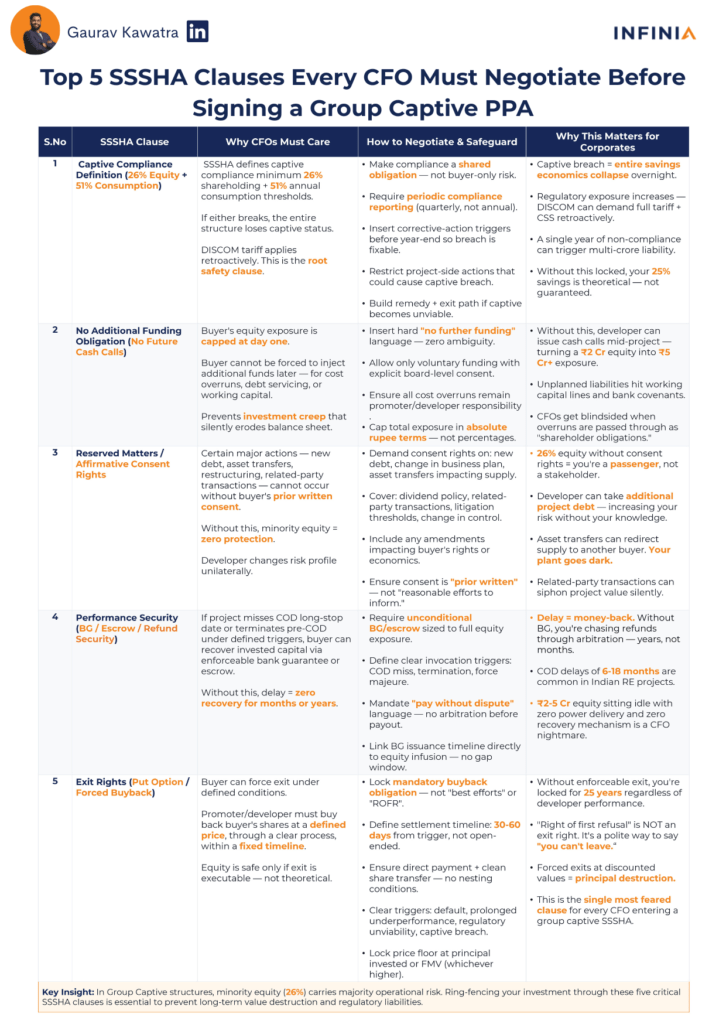
The CFO had negotiated the commercial terms well, but he needed a raw, real, experience-based advisory to defend the equity structure against these specific legal risks.
He reached out to us to build a precise framework around these exact concerns. We presented him with a boardroom-grade SSSHA framework covering the top 5 clauses every CFO must lock down when entering a Group Captive or Captive Open Access structure.
Instead of relying on the developer’s standard draft, the framework detailed:
- What these specific clauses are.
- Why each one matters to the corporate balance sheet.
- Exactly how to negotiate them to shift the risk back to the developer.
The Verdict: A Legally Sound Energy Strategy
Armed with this exact SSSHA framework, the CFO did not just present projected savings to the Board; he presented a legally defended asset. By locking in strict Performance Securities, defining clear Cross Subsidy Surcharge indemnities, and structuring ironclad Put/Call options, the 85.7% IRR was no longer just a projection—it was legally protected capital.
Next Steps for the Boardroom
If you are evaluating an Open Access Term Sheet, do not assume your equity is protected. The developer’s SSSHA is drafted to protect the developer, not your balance sheet.
If you are preparing to sign an SSSHA for a Solar or Wind-Solar Hybrid project and want us to run a Techno-Commercial Wealth Audit to stress-test your equity structure and exit rights:
In this session, we will audit your exact term sheet, protect your IRR, and ensure you walk into your next Board meeting with a mathematically and legally sound energy strategy.
About Infinia Solar
Infinia Solar is India’s leading renewable energy consultant.
We help Commercial and Industrial consumers procure the right renewable energy solutions, from the right developers, and on the right PPA terms.
We’ve served 60+ customers across 18 states, enabling 1.4 GW of open access and rooftop solar capacity, and have facilitated 150+ PPAs so far.
This has helped our customers reduce up to 50% of their electricity costs and replace up to 100% of their power with renewable energy.
We have also collaborated with 50+ developers, and our customers fondly refer to us as the ‘Amazon of the renewable energy industry.‘