
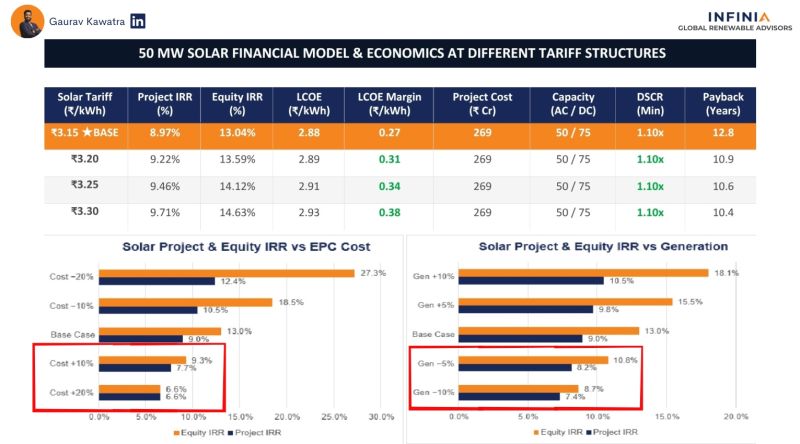
Executive Summary
A Maharashtra-based listed steel manufacturer was looking to procure a 50 MW Open Access Solar solution. The Board was presented with a highly attractive ₹3.15/unit tariff (the L1 bid), promising maximum savings against their current grid costs. However, the CFO refused to sign the 25-year Power Purchase Agreement (PPA) blindly. By intervening with a forensic Financial Model, we reverse-engineered the developer’s bid and revealed a fatal flaw: the ₹3.15 tariff was a “suicide bid” with a dangerously thin 8.97% Project IRR. Recognizing the severe risk of a stranded asset, the Board disqualified the cheapest bid in favor of execution certainty.
Here is the exact mathematical breakdown of how we decoded the L1 Trap.
The Mandate: A Triple Threat
For this steel giant, energy transition was not just about green optics; it was about operational survival. The CFO had a strict, three-pronged mandate for this 50 MW procurement:
- Direct Cost Reduction: Achieve savings of ₹2.5 to ₹3/unit against their punishing ₹9 grid tariff.
- ESG Compliance: Meet immediate and strict ESG goals required as a publicly listed company.
- Export Security: Defend against aggressive pressure from the European export market, which is actively banning and rejecting “Black Power” steel.
The Illusion: The “No-Brainer” L1 Bid
After scanning the market, the company received four competitive pitches from developers:
- Developer A: ₹3.15 / unit (The L1 Bidder)
- Developer B: ₹3.20 / unit
- Developer C: ₹3.25 / unit
- Developer D: ₹3.30 / unit
Naturally, the Board leaned toward Developer A. In traditional corporate procurement, the lowest bidder (L1) almost always wins. But to the CFO, a ₹3.15 tariff in the current market sounded a bit too good to be true. It smelled fishy.
The Reality Check: Asking the Right Boardroom Questions
Before locking his company into a 25-year “marriage,” the CFO refused to fall blindly into the L1 Trap. He required forensic due diligence on the developer’s actual project costs.
He asked the sharp boardroom questions that most executive teams miss:
- How did these developers actually arrive at these tariffs?
- What returns (Project IRR and Equity IRR) are they truly making at these price points?
- Are we squeezing them so hard that the project will stall mid-construction?
- What happens to their mathematical models if project costs rise or generation drops?
The Forensic Audit: Reverse-Engineering the Math
The CFO reached out to us to decode the developers’ numbers. We ran the math and built a forensic Financial Model that categorically stress-tested the ₹3.15 bid.
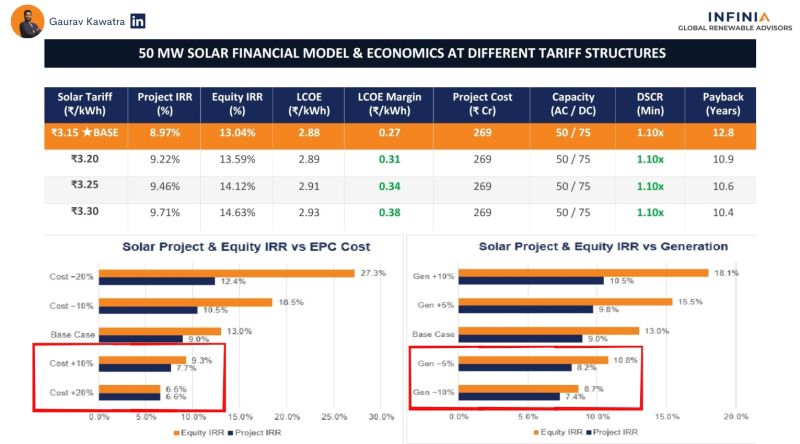
The brutal reality of the analysis was screaming: The “cheap” tariff left zero room for error.
Here is exactly what the sensitivity analysis revealed:
- The Margin Trap: At ₹3.15, the developer’s baseline Project IRR was a mere 8.97%.
- The EPC Risk: If project EPC (Engineering, Procurement, and Construction) costs increased by just 10%, their Equity returns would crash to 9.3%.
- The Generation Risk: If generation dropped by just 10% due to weather or technical faults, Equity returns would tank to 8.7%.
This was a suicide bid. One minor supply chain hiccup or one bad weather year, and the developer would abandon the project. The steel company would be left with a stranded asset, missed financial targets, and failed ESG commitments.
The Verdict: Execution Certainty Over Spreadsheet Savings
The CFO took these exact insights back to the Board. Armed with the forensic Financial Model, the narrative completely changed.
The Board unanimously disqualified the ₹3.15 bid. Instead, they approved a mathematically sound developer who possessed enough margin to guarantee execution certainty, and safely signed the PPA.
In Renewable Energy, the cheapest bid is rarely the safest. Execution certainty will always beat a spreadsheet illusion.
Next Steps for the Boardroom
If you are an industrial consumer evaluating a long-term PPA, do not make a 25-year capital commitment based on a basic tariff comparison. You must reverse-engineer the developer’s financial model to ensure your asset will actually be built.
If you want us to run a Techno-Commercial Wealth Audit to stress-test your developers’ bids and build the legally and mathematically bulletproof strategy your Board needs to see, connect with us to reserve your strategy session today.
About Infinia Solar
Infinia Solar is India’s leading renewable energy consultant.
We help Commercial and Industrial consumers procure the right renewable energy solutions, from the right developers, and on the right PPA terms.
We’ve served 60+ customers across 18 states, enabling 1.4 GW of open access and rooftop solar capacity, and have facilitated 150+ PPAs so far.
This has helped our customers reduce up to 50% of their electricity costs and replace up to 100% of their power with renewable energy.
We have also collaborated with 50+ developers, and our customers fondly refer to us as the ‘Amazon of the renewable energy industry.‘